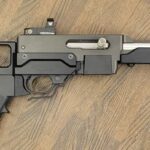
The Smith & Wesson FPC has been out for about a year now. When they first dropped, every reviewer and their dog had a “first look” video, but now that the dust has settled, we can look at how these things actually hold up after the honeymoon phase.
The FPC is S&W’s entry into the folding pistol caliber carbine (PCC) market, and it is clear they had one specific competitor in their crosshairs: the Kel-Tec Sub-2000. While it hits many of the same notes, the FPC takes a very different path to get there.
Note: this rifle is now prohibited in Canada.
Overview
The FPC is a 9mm, blowback-operated carbine that folds to the side rather than over the top. It is built primarily out of plastic (or “high-strength polymer” if you are a marketer), but it feels chunky and substantial. It ships with one 17 round and two 23 round magazines (or three 10 rounders if you are here in Canada), and the stock itself acts as a carrier for those two spare mags.
Specifications
- Caliber: 9mm
- Action: Blowback
- Barrel Length: 16.25 inches for Americans, 18.6″ for Canadians
- Weight: Approximately 5 lbs
- Magazine Type: S&W M&P M2.0
- Safety: Crossbolt
- MSRP: Approx. $1,000 CAD
Usability: The Good and the Weird
The biggest win for the FPC is the folding mechanism. Because it folds to the side, your optics stay mounted on the top rail. Unlike the Sub-2000 (Gen 1 or 2), you do not have to buy a goofy pivoting mount to keep your Red Dot. However, because the rail is so far forward, this is strictly a Red Dot gun. You are not going to get the eye relief needed for a traditional scope.
The Magazine Situation: S&W opted for a compact-length grip. This allows it to take any M&P mag, but it means the longer mags come with these plastic spacers to fill the gap. I am not a fan. They feel like a cheap solution, and if you do not glue them down, they just rattle around.
The Stock: The stock holds two spare magazines. Some reviewers say it is clunky to use, and I agree. You have to press a button and pull from the opposite side. It makes the buttstock unnecessarily wide. I would honestly prefer a thinner stock without the onboard storage, as the extra bulk makes it harder to slide into a slim backpack.
Controls:
- Charging Handle: It is a non-reciprocating handle located under the buffer tube. It is plastic and can be a bit sticky out of the box until the “flashing” wears down.
- Bolt Release: It is technically ambidextrous, but it is extremely stiff. Do not expect to use it like a “go-fast” slide release; you are better off just racking the charging handle.
- Trigger: It comes in at about 5 lbs. It has some “squish” but a decent break. It is fine for a PCC, but it is not going to win any precision awards.
Disassembly and Maintenance
One thing missing from early reviews was a look at the “guts.” Taking the FPC apart is surprisingly easy.
- Remove the buttstock by pulling the top lever.
- Pop the rear pin to release the recoil spring.
- The bolt is a heavy, two-piece steel assembly.
The chamber is very easy to access for cleaning once the gun is folded, which is a huge plus since blowback 9mms get filthy fast.
Aftermarket and Potential Modifications
Since this is a relatively new platform, the aftermarket is still catching up.
- Muzzle Devices: The barrel is threaded. I added a Maple Ridge Armory brake to mine, though gas pressure at the end of a 16 inch 9mm barrel is low enough that it is mostly for looks.
- Stocks: Companies like Taccom are looking at slimmer aftermarket stocks that delete the magazine storage, which would be my first upgrade.
- Slings: The factory sling points are in weird spots. There is a QD cup on the bottom, but the gun wants to flip upside down. You will likely need to add an M-LOK QD mount to the handguard for a proper two-point setup.
Competitors
vs. Kel-Tec Sub-2000 The Sub-2000 is slimmer and folds more compactly. However, the FPC is much easier to mount an optic on and feels more “solid” (less like a collection of screws and clamshells). The FPC uses M&P mags, while the Sub-2000 is famous for its Glock mag compatibility.
vs. Ruger PC Carbine The Ruger is a “takedown” rather than a folder. It is more robust and has a better aftermarket for triggers and stocks, but it does not pack away as quickly as the FPC. The FPC is also significantly lighter in the front end because the handguard is just two pieces of plastic clamshelled over the barrel.
Conclusion
The S&W FPC is a reliable, clever little carbine. It is not “refined”—there is a lot of plastic, and the stock is a bit of a boat anchor—but it works. If you already own an M&P pistol and want a companion PCC that can actually hold a Red Dot while folded, this is the one to get. If you are looking for the absolute smallest footprint possible, the Kel-Tec still holds that crown.